Planetary orbits make sense once gravity, motion, and distance are considered together. Every planet moves around the Sun, but an orbit is not a circular track fixed in space.
It is the continuing result of a planet’s velocity and the Sun’s gravitational pull. The same principles apply to moons around planets and to many human-made satellites around Earth.
Gravity Changes Direction
An object in motion tends to continue in a straight line unless a force changes its movement. The Sun’s gravity continuously accelerates a planet toward the Sun, changing the direction of its velocity. The planet’s existing sideways motion carries it forward while gravity curves the path. A stable orbit results when these effects produce a repeating route rather than an inward impact or an escape into distant space.
Distance matters because gravitational attraction weakens as two bodies move farther apart. Mass matters as well, although both bodies pull on each other. The Sun moves slightly in response to the planets rather than remaining completely fixed. For basic solar-system diagrams, treating the Sun as a central reference is accurate enough, but precise calculations use the shared center of mass for the bodies involved.
Ellipses Set the Path
Planetary orbits are ellipses, with the Sun located at one focus instead of at the geometric center. Most planetary ellipses are close to circles, so the difference can be difficult to see in a simple illustration. Their distances from the Sun still change during each orbit. The nearest point is called perihelion, and the farthest is called aphelion.
An elongated drawing may exaggerate this shape for teaching purposes, while a decorative diagram may show exact circles. Neither should be treated as a measurement unless the scale is stated. Orbital orientation also matters: viewed from above the Sun’s north pole, the planets travel in the same general direction. Their paths lie close to a shared plane called the ecliptic, though they are not aligned with it exactly.
Distance Changes Speed
A planet does not move at constant speed along its elliptical path. It travels faster near perihelion and more slowly near aphelion. This pattern is described by the principle that an imaginary line from the Sun to the planet covers equal areas during equal time intervals. The changing speed conserves angular momentum while gravity continues to act throughout the orbit.
The effect should not be confused with a planet’s rotation, which is its spin around an axis. Rotation determines the length of a local day, while revolution around the Sun determines the orbital period. A planet can rotate slowly yet orbit relatively quickly, or rotate quickly while taking many Earth years to complete its route around the Sun. These motions have different causes and measurements.
Periods Reveal a Pattern
Planets farther from the Sun generally have longer orbital periods because their paths are larger and their orbital speeds are lower. Mercury completes an orbit in about 88 Earth days, Earth in about 365 days, and Saturn in about 10,759 days. These values illustrate a mathematical relationship between orbital size and period rather than a simple increase by the same number of days from one planet to the next.
The relationship also helps scientists estimate motion in other systems when enough measurements are available. For two bodies orbiting the same central mass, a larger average orbital distance corresponds to a longer period in a predictable way. Real calculations may include the masses of both bodies and effects from neighboring objects. Long-term predictions therefore use numerical models when small gravitational interactions become important.
Read Diagrams Carefully
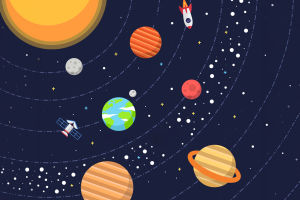
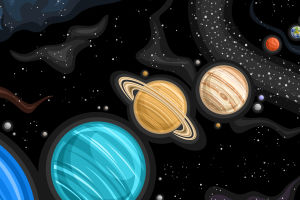
A useful orbit diagram should be read for the concept it was designed to show. Some visuals emphasize planet order; others show relative orbital size, direction, speed, or position on a particular date. If all eight planets appear large and close together, the sizes and distances cannot both be to scale. Check the caption or legend before using spacing, color, or alignment as scientific data.
Static pictures also freeze a system whose parts move at different rates. A row of planets does not mean they remain on one side of the Sun, and equal gaps on a page do not indicate equal travel times. A reliable visual guide separates rotation from revolution, labels the viewing direction, and states when distances or planet sizes are compressed. Those details turn an attractive layout into an accurate learning tool.
Planetary motion becomes understandable when gravity is treated as a continuous change in direction, not as a force that simply holds objects still. Reading orbit graphics with attention to scale, shape, and purpose helps connect the illustration to the real mechanics.